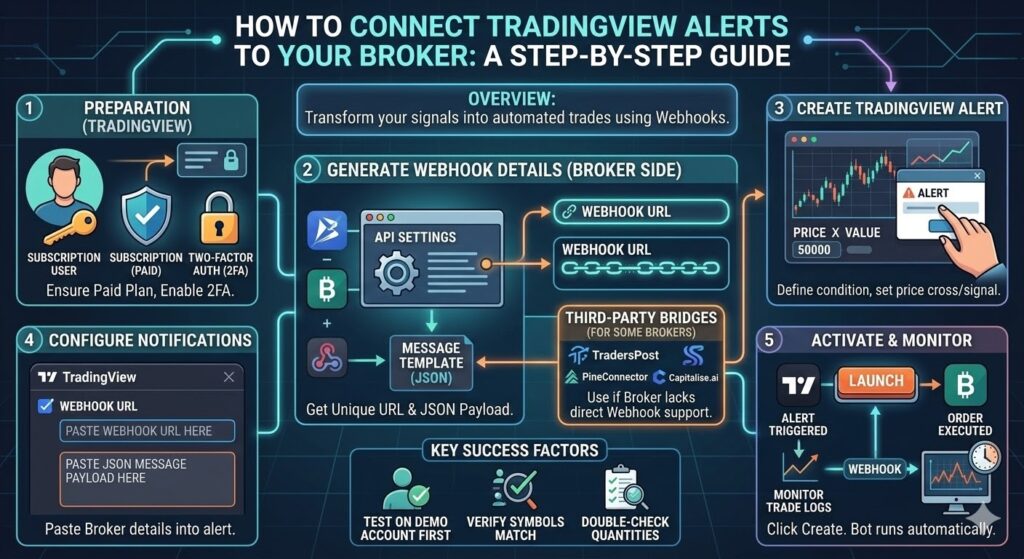
Automated trading has become increasingly popular among traders who want to execute strategies faster and more consistently. Many traders rely on TradingView to analyze markets, build strategies, and generate trading alerts based on technical indicators or custom scripts.
However, TradingView itself does not execute trades on most brokers. Instead, it sends alerts when certain conditions occur. These alerts notify traders that a trading signal has been triggered.
To fully automate trading strategies, traders need a way to connect TradingView alerts to their broker accounts so that trades can be executed automatically.
This is achieved using webhook automation platforms that receive TradingView alert signals and convert them into broker orders.
In this guide, we will explain how to connect TradingView alerts to your broker step-by-step and how traders can build automated trading systems without coding.
Why Connect TradingView Alerts to Your Broker?
Connecting TradingView alerts directly to a broker allows traders to automate their strategies.
Instead of manually placing trades after receiving alerts, automated systems execute trades instantly when signals occur.
Here are some of the key advantages.
Faster Trade Execution
Automated systems place orders immediately after a signal is generated, reducing delays that can occur during manual trading.
Consistent Strategy Execution
Automation ensures that strategies are executed exactly according to predefined rules.
Reduced Emotional Trading
Automated systems remove emotional decision-making from trading.
24/7 Trading
Automation allows strategies to run continuously, which is especially important in cryptocurrency markets that operate around the clock.
How TradingView Alerts Connect to Brokers
TradingView alerts connect to brokers using webhook automation.
The automation workflow typically looks like this:
TradingView Strategy
↓
TradingView Alert Trigger
↓
Webhook Signal Sent
↓
Automation Platform Receives Signal
↓
Broker API Executes Trade
In this architecture:
- TradingView generates the signal
- Webhooks deliver the signal to an automation platform
- The automation platform converts the signal into a broker order
This structure allows traders to create fully automated trading workflows.
Step-by-Step: Connect TradingView Alerts to Your Broker
Follow these steps to connect TradingView alerts to your broker.
Step 1 — Create a Trading Strategy in TradingView
Start by creating or selecting a trading strategy.
Strategies can be based on:
- technical indicators
- price levels
- Pine Script strategies
Common strategy examples include:
- moving average crossovers
- RSI signals
- breakout strategies
The strategy should clearly define buy and sell conditions.
Step 2 — Create a TradingView Alert
Once your strategy generates signals, create an alert.
Steps:
- Open your TradingView chart
- Click Create Alert
- Select the condition that triggers the signal
- Enable Webhook URL
- Enter the webhook endpoint
The alert will trigger when the strategy condition occurs.
Step 3 — Add a Webhook Endpoint
The webhook endpoint is the URL where TradingView sends the alert signal.
Example webhook endpoint:
https://postingtrader.com/webhook/strategy-id
When the alert triggers, TradingView sends a webhook request containing a JSON message.
Step 4 — Configure the JSON Signal
Webhook alerts typically contain structured JSON messages.
Example signal:
{
 "action": "buy",
 "symbol": "BTCUSDT",
 "quantity": 1
}
Advanced signals can include additional parameters.
{
 "action": "buy",
 "symbol": "BTCUSDT",
 "quantity": 1,
 "stop_loss": 39500,
 "take_profit": 42000
}
These JSON messages allow automation platforms to understand what trade should be executed.
To learn more about JSON signals, read our guide on TradingView webhook JSON examples.
Step 5 — Connect Your Broker
Automation platforms connect directly to broker APIs.
When a webhook signal is received, the platform converts the JSON message into a trade order executed through the broker.
Once connected, your system can execute trades automatically whenever alerts occur.
Platforms That Help Connect TradingView Alerts to Brokers
Several automation platforms allow traders to connect TradingView alerts to broker accounts.
Examples include:
- PostingTrader
- TradersPost
- PineConnector
- Capitalise.ai
These platforms act as the bridge between TradingView signals and broker execution.
PostingTrader focuses specifically on allowing traders to automate TradingView alerts and connect them directly to broker accounts without coding.
Example Automated Trading Workflow
Below is an example of how a fully automated trading system works.
Strategy detects signal
↓
TradingView alert triggers
↓
Webhook sends JSON signal
↓
Automation platform receives signal
↓
Broker executes trade
This entire process can occur within seconds.
Benefits of Connecting TradingView Alerts to Your Broker
Automation platforms provide several advantages.
Instant Trade Execution
Webhook automation executes trades instantly when signals occur.
Reduced Human Error
Automation eliminates mistakes caused by manual trading.
Strategy Scalability
Traders can run multiple automated strategies simultaneously.
Continuous Operation
Automated systems can run 24 hours a day.
Risks to Consider
Although automation provides many advantages, traders should consider potential risks.
Strategy Performance
Poorly designed strategies may generate losing signals.
Always backtest strategies before automation.
Incorrect Webhook Signals
Webhook messages must be formatted correctly.
Risk Management
Automated systems should always include:
- stop loss levels
- position sizing
- risk limits
Best Practices for Connecting TradingView Alerts to Brokers
To ensure reliable automation, traders should follow best practices.
Test Your Strategy First
Backtest strategies before deploying them in live trading.
Start With Paper Trading
Test automation systems in simulated environments.
Monitor Your Automation
Even automated systems should be monitored regularly.
Implement Risk Controls
Always define risk limits and stop losses.
FAQ
Can TradingView connect directly to brokers?
TradingView supports limited broker integrations, but most automated trading setups require webhook automation platforms.
Do you need coding to connect TradingView alerts to brokers?
No. Automation platforms allow traders to connect TradingView alerts to brokers without coding.
What is the easiest way to automate TradingView alerts?
The easiest method is sending webhook alerts from TradingView to an automation platform that executes trades on a broker.